
Formula 1
Ten seats. $34.2 billion. Five years earlier they were worth around $5 billion, in a sport that bankrupted team owners.
ALL BREAKDOWNSTHE BREAKDOWN
7/23/20266 min read
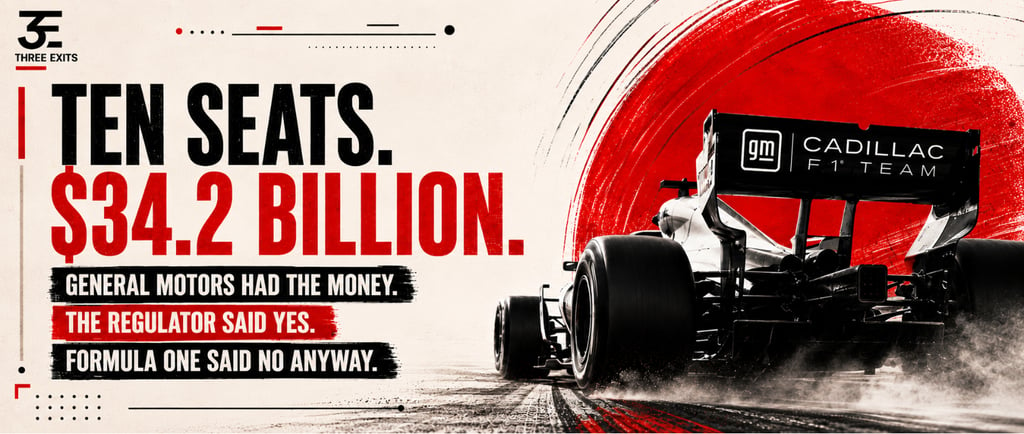
Ten seats. $34.2 billion.
Five years earlier they were worth around $5 billion, in a sport that bankrupted team owners.
General Motors arrived with billions to spend and a technical bid the regulator had already approved. Formula One told it no anyway.
____________________
THE SETUP
In January 2024, General Motors tried to buy its way into Formula One. It had the money and met every requirement.
The FIA, Formula One's regulator, had approved its Andretti Cadillac team to enter the grid three months earlier. Every technical and sporting box was ticked.
Formula One's commercial rights holder rejected the application. The FIA decides who is fit to race. Formula One Management decides whether letting them race is worth the money to the ten teams already on the grid.
The reason given had little to do with the cars. It came down to whether the team's owner had shown its seat would be worth more to the other ten teams than it cost them in a diluted paycheque.
For most of Formula One's history winning didn't guarantee survival and losing didn't guarantee an exit.
That stopped happening around 2021. The cars kept racing at the same speed. The economics underneath them changed completely.
____________________
FAST FACTS:
The fee charged to any new team joining the grid rose from $200 million to $450 million in four years
Average team value, per Sportico's estimates: roughly $500 million in 2019, $1.88 billion in 2023, $3.42 billion in 2025
Seven of the ten teams reported a profit in 2022, the first time that had happened across the grid
Ten teams were worth an estimated $34.2 billion combined by November 2025
What changed and why did turning a carmaker away make every remaining seat worth more? The Andretti Cadillac rejection is the focal point.
____________________
THE PLAYBOOK
1. Two approvals, only one about racing
Under Formula One's Concorde Agreement, the contract binding the FIA, the ten teams and the commercial rights holder, joining the grid needs two separate approvals.
The FIA judges sporting and technical fitness. Formula One Management judge, whether the new team adds enough value to justify cutting the other ten teams' share of the prize pool.
Andretti passed the first test in October 2023. It failed the second in January 2024.
Formula One Management's rejection ran to 1,400 words. Its central line: adding an eleventh team would not enhance the championship's value. It went further, arguing the Andretti brand would gain more from Formula One than Formula One would gain from Andretti.
Michael Andretti called himself devastated. Twelve members of the US Congress went further. They wrote to Liberty Media invoking the Sherman Antitrust Act, accusing the sport's structure of excluding an American competitor by design.
A congressional antitrust letter over who gets to race a car isn't a routine business dispute. It's what it looks like when a market's gatekeepers get caught pricing out a rival.
McLaren's Zak Brown offered a hypothetical at the time, arguing the fee itself was too low rather than the bid. Pay $700 million instead of $200 million, split ten ways, and each existing team pockets $70 million against roughly $10 million a year of real dilution.
A year later a restructured bid returned. General Motors led it directly under the Cadillac name, with Andretti no longer the principal owner, committed to building its own power unit over time and backed by a $450 million entry payment, more than double the original $200 million and split equally among the ten existing teams.
It was approved within months.
The ownership changed. The power unit plan changed. The number that decided it, was the cheque.
Formula One wasn't testing whether a new team could be competitive. It was testing whether a new team would pay what the existing ten now believed their own seats were worth.
____________________
Takeaway: when incumbents get to set the price of joining their own market, the entry fee stops measuring cost and starts measuring how much they believe their existing stake is worth.
____________________
2. The rule that turned revenue into profit
Why did seven of the ten teams turn a profit for the first time in the sport's history, on revenue that had been rising for years before that? The answer isn't more money coming in. It's a rule that stopped them setting fire to it.
Before 2021, extra revenue in Formula One had one real destination: faster cars.
Teams spent whatever came in chasing an arms race most of them couldn't afford. Turnover rarely became profit.
Manor, Caterham and HRT all went under in the decade before the cap, teams that spent what came in chasing lap time until there was nothing left to spend.
The 2021 Concorde Agreement introduced a hard cap on car development spending, roughly $145 million a season and adjusted for race count and inflation, alongside team payments tied directly to Formula One's own operating profit.
Seven of the ten teams reported a profit in 2022, a first for the sport. Mercedes' UK entity's profit nearly doubled between 2021 and 2024, according to its own published accounts, on turnover that grew alongside Formula One's own revenue, which roughly doubled over the same period.
A decade earlier, under CVC Capital Partners, Formula One's revenue also grew sharply. Most teams still cycled through distressed sales anyway. Williams and what is now Aston Martin both changed hands for under $200 million in that period.
The cap didn't make every team profitable by itself. It removed the one reason most of them stayed unprofitable: a rival always willing to outspend them.
Revenue growth alone never made these teams valuable. It took a rule that stopped them spending it on lap time.
____________________
Takeaway: the money coming in never made these teams valuable. The cap did, because it decided whether that money reached the bottom line instead of the car
____________________
3. Ferrari's separate contract
Playbook one is about pricing outsiders out. Playbook three is the same logic pointed inward: paying your most valuable insider enough that they never want to leave.
Scarcity explains why a seat is expensive. It doesn't explain why one seat costs the other nine money just to keep occupied.
One team never negotiated under the same terms as the other nine. Ferrari receives a heritage payment reported at roughly 5 percent of the prize pool, paid regardless of where it finishes, in recognition of having raced in every Formula One season since 1950.
That payment is estimated at $60 million to $80 million a year.
Reporting on both the 2021 and 2026 Concorde agreements suggests the arrangement has been preserved.
Sportico's 2025 estimate placed Ferrari's Formula One operation at $6.4 billion, the highest of any team. Smaller teams have objected to the arrangement for years. It has never been removed.
A shopping centre often rents space to its biggest department store below market rate, because that store's name on the building is what pulls customers past every smaller shop around it.
The other nine teams are doing the same thing. Ferrari's presence is part of why their own seats are worth more, not an unrelated perk it happens to collect on the side.
____________________
Takeaway: paying your most valuable member less than they could charge elsewhere sometimes protects the value of everyone else's stake in the room.
____________________
WHAT GETS MISSED
Most coverage of the Andretti rejection framed it as a fairness dispute, European teams protecting themselves against an American entrant. That framing missed the test being run.
None of the other nine teams called it exclusion. They called it protecting the value of their own seat. Every time a new entrant is forced to pay more than the last one did, the seats already sold get more valuable by definition, because the price of entry becomes the market's own evidence of what a seat is worth.
Speed never decided who got a seat. The other ten teams did.
Every closed market has ten teams and one price. The only question is whether you're the one setting it or the one being told no.
____________________
THE PAPER TRAIL
Liberty Media’s Concorde cost-cap, August 2020
3 minute read
The agreement that turned rising revenue into rising profit, by capping car spend and tying team payouts to F1’s own operating income. Read it as the moment franchises became investable.
https://speedcafe.com/the-secret-f1-concorde-agreement-explained/
____________________
Zak Brown’s franchise math on Andretti’s entry fee, September 2023
2 minute read
McLaren’s CEO explains why a US$700m fee could make every existing seat more valuable despite dilution. It’s the clearest on-record articulation of F1’s franchise logic from inside the grid.
https://www.blackbookmotorsport.com/news/andretti-f1-mclaren-boss-zak-brown/
____________________
Alpine’s €200m stake sale to RedBird and Ryan Reynolds, June 2023
4 minute read
A live transaction where outsiders price a mid-grid team at US$900m. It quietly shows how Concorde-era cash flows and scarcity translate into real-money enterprise values.
https://media.renaultgroup.com/alpine-racing-ltd-finalises-the-sale-of-24-of-its-share-capital-for-eur200m-to-investor-group-led-by-otro-capital/
____________________
McLaren Racing’s £3bn valuation in the Mumtalakat/CYVN deal, September 2025
5 minute read
The moment sovereign wealth funds marked a single F1 team at more than US$4bn. This is the cleanest datapoint for how far franchise economics have pushed valuations beyond what on-track results alone would justify.
https://www.bloomberg.com/news/articles/2025-09-01/mclaren-f1-team-valued-at-more-than-3-billion-in-stake-sale
____________________
US Congress’s antitrust letter over Andretti–Cadillac, May 2024
3 minute read
A bipartisan warning shot that treats F1’s entry fee and licence scarcity as an anticompetitive gatekeeping device. It reframes the Andretti rejection as a test of how far closed-franchise logic can go before regulators intervene.
https://www.nytimes.com/athletic/5464256/2024/05/01/f1-congress-letter-antitrust-andretti-gm/
____________________