
OceanGate:
OceanGate paid $10,000 to seal the report that said Titan should not be manned. Then sold seats on the submarine at $250,000 each.
ALL BREAKDOWNSTHE BREAKDOWN
6/11/20267 min read
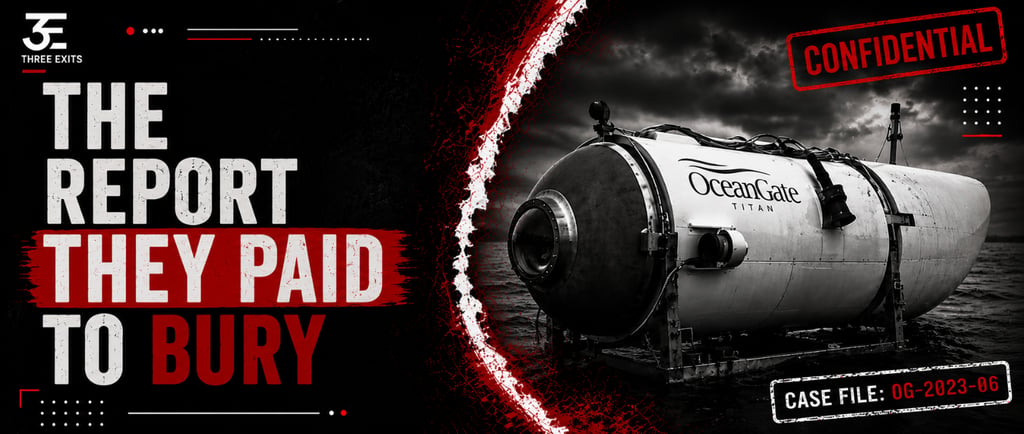
OceanGate paid $10,000 to seal the report that said Titan should not be manned.
Then sold seats on the submarine at $250,000 each.
Read time: 5 minutes
____________________
THE SETUP
David Lochridge told Stockton Rush that Titan should not be manned.
Three days later he was fired.
When he filed an OSHA complaint, OceanGate sued him. The settlement required him to withdraw the complaint, sign an NDA and pay roughly $10,000 of OceanGate’s legal fees.
The federal investigation stalled. The report was sealed. The Coast Guard would later call that stalled OSHA case a missed regulatory intervention.
OceanGate continued.
Five years later, Titan imploded.
The most important number in the story is 90. That is how many dives OceanGate cited in the passenger waiver as a safety track record.
Of those 90, 49 came from a scrapped earlier hull. The carbon fibre hull, passengers were being sold seats on, had completed 11 operational dives, to a maximum of 170 metres.
Passengers were signing up for 3,840 metres of pressure on a hull that had never been tested deeper than the height of a five-storey building.
The 90 in the waiver was the track record of a different vessel.
OceanGate didn’t ignore the warnings. It removed the people giving them, then pointed to the silence as proof the submarine was safe.
____________________
FAST FACTS:
Of the 90 dives cited in the waiver, 49 came from a scrapped hull. The final hull had completed 11 dives, to 170 metres maximum
The hull was showing signs of structural damage after dive 80 in 2022. More damage after dive 82. OceanGate kept diving
$250,000 per seat. $1.25m maximum revenue per expedition. Seasonal operating costs estimated at $2–5m
OceanGate raised approximately $19m in 2020, described by Rush as “100% insiders”
$447,000 emergency debt round filed shortly before the fatal June 2023 expedition. Staff working on deferred pay
Wrongful death suits seeking more than $50m have since produced internal emails, corroborating what Lochridge documented in 2018
The Coast Guard Marine Board published its 300-page report in August 2025. The implosion was preventable
____________________
THE PLAYBOOK
1. The 90 dives that weren’t what they claimed
Every successful dive was filed as proof the warnings were wrong.
The Coast Guard found Rush had “seemingly used inflated numbers to bolster the perceived safety and dive count of the final Titan hull.”
In other words: the number on the waiver was not an accident. It was a choice about what to count.
Passengers thought they were buying a ticket on a vessel with 90 dives of history. The relevant hull had 11.
The waiver’s 90 was another vessel’s history. This hull had eleven tries.
The hull was showing structural damage after dive 80. More damage after dive 82. The monitoring system was flagging it.
There was nobody left inside OceanGate to act on it.
OceanGate was not a tourism company. Rush founded it to develop technology for deep-sea research and eventually commercialise access to the ocean floor.
It was a venture-backed science project trying to fund itself through tourism.
That meant pausing for safety wasn’t just operationally inconvenient. OceanGate was burning $2–5m per expedition season, had raised roughly $19m from insiders and took an emergency $447,000 debt injection shortly before the fatal June 2023 expedition. Staff were deferring pay.
OceanGate wasn’t choosing between safety and growth. It was choosing between safety and survival. The safest decision available to the company may have been the one that ended it.
A hull anomaly was not just an engineering problem. It was a direct threat to the only revenue stream keeping the company alive.
Passengers saw 90 dives and assumed safety.
____________________
Takeaway: Thirteen uneventful dives means thirteen dives did not produce a visible failure. Nothing more. Every business has a version of this, a run of good results that gets mistaken for proof the risk isn’t there. It isn’t proof. It’s just the count so far.
____________________
2. Remove the engineer, keep the count
When a director of marine operations raises 25 specific concerns and recommends the vessel should not be manned, that is governance working as designed. Rush treated it as a personnel problem.
What happened: report submitted, meeting the following day, Rush rejects unmanned testing, Lochridge fired three days later, OSHA complaint filed, draft lawsuit sent, settlement with an NDA, federal investigation shelved.
It converted Lochridge’s documented concerns into a sealed record.
The report that said Titan should not be manned could no longer be cited, discussed or built on by anyone bound by its terms. The concerns did not stop existing. They stopped being reachable.
When OceanGate filed its suit in June 2018, Lochridge’s counterclaim described a company that denied him engineering data, met safety concerns with hostility and used litigation to end a challenge to its direction.
The Coast Guard later called the OSHA investigation a missed regulatory intervention.
Private litigation had neutralised a federal process that could have forced changes before a single paying passenger boarded.
By the time Titan imploded, every functioning correction mechanism had been removed.
The certification bodies had been formally rejected in a corporate blog post.
A March 2018 letter signed by 38 industry experts warning of catastrophic consequences had been dismissed.
Hull anomaly data from 2022 had not been acted on.
Lochridge had been gone for five years.
In that model, a director of marine operations who knows when to say stop isn’t a risk manager. He’s a revenue blocker.
Every governance failure eventually became another positive contribution to the 90-dive statistic.
____________________
Takeaway: When the cost of raising a concern is high enough, people stop raising them. That doesn’t mean the concerns go away. It means you stop hearing about them before they become a crisis.
____________________
3. The ideology that made every warning look identical
Rush was not an amateur who got lucky for a while.
He held a Princeton aerospace engineering degree, had worked as a flight test engineer on the F-15 at McDonnell Douglas, was a commercial pilot and had built experimental aircraft.
His credentials explain why the warnings were so easy to dismiss.
Rush had not simply decided to skip certification. He had built a philosophy that automatically downgraded every warning he received.
In 2018 emails with deep-sea consultant Rob McCallum, Rush wrote that he was “tired of industry players who try to use a safety argument to stop innovation.”
He described certification bodies as defenders of “a small existing market” who used safety language to block new entrants.
His public statements followed the same logic. Regulations were “obscenely safe.” “At some point safety is just pure waste.”
In 2019, OceanGate published a formal blog post explaining why Titan was not certified.
Classification is “anathema to rapid innovation.” This was not a one-off explanation. It was a documented corporate position.
By 2023, Titan was effectively alone: one of roughly ten submersibles capable of Titanic depth and the only one not certified by any independent body.
The March 2018 letter from 38 experts, including the chairman of the Manned Underwater Vehicles Committee, warned explicitly that OceanGate’s approach could have catastrophic consequences.
Under Rush’s framework, they were exactly what he had predicted: industry players protecting a small existing market. The letter became confirmation.
A decision can be revisited. A philosophy converts incoming evidence into support for itself.
OceanGate’s luck ran out at 3,800 metres. The systems that failed weren’t just in the hull. They were in the org chart.
____________________
Takeaway: Every founder has a belief system that explains away uncomfortable information. Rush’s just happened to be documented. Every near-miss you survive without consequence becomes evidence your judgment is sound. It isn’t. It’s just luck you haven’t run out of yet.
____________________
WHAT GETS MISSED
Five people died. Rush and four paying passengers. The Coast Guard concluded it was preventable.
Most coverage of OceanGate focuses on the engineering. The carbon fibre hull. The viewport rating. The Logitech game controller used to pilot a submersible at 3,800 metres. These details are accurate. They are not the story.
OceanGate did not solve the engineering problem. It solved the disagreement problem.
The people paying $250,000 for a seat, thought they were buying access to the Titanic. What they were actually buying was OceanGate’s confidence in itself.
OceanGate paid $10,000, extracted from the man who tried to stop it, to seal the report that said Titan should not be manned.
That money bought silence. Then OceanGate sold the silence as safety.
The OSHA investigation that might have forced external review was stopped by private litigation.
The MTS letter was dismissed.
The 2022 hull anomaly data was not acted on.
At every stage where an outside voice might have reached the people paying $250,000 for a seat, a legal, commercial or cultural mechanism removed it.
Every passenger who boarded Titan was buying a ticket on the other side of that NDA.
Rush’s public statements about regulation are usually read as arrogance.
They were a coherent operating philosophy that converted every qualified critic into an example of the problem he was trying to solve.
The more qualified the critic, the more clearly they fit the category he had already created for them.
Every time a complaint disappeared, OceanGate called it progress. The complaints didn't disappear. They were removed.
Most founders who fail were warned. They just had a good reason not to listen.
The distance between Stockton Rush and every founder who got away with dismissing a warning is not character. It is consequences.
If you cannot name the person inside your company whose job is to tell you no, you are not the exception to this story. You are just earlier in the timeline.
____________________
THE PAPER TRAIL
US Coast Guard Marine Board of Investigation Report on Titan (2025)
Read: 30 minutes (Longer for the full 300‑page report).
The definitive official account. 300 pages covering the hull failure, the workplace culture and the 2022 anomaly data that was never acted on. The section on how private litigation neutralised the OSHA investigation is the key passage.
https://www.news.uscg.mil/News-by-Region/Headquarters/Titan-Submersible/
____________________
Marine Technology Society letter to OceanGate (March 27, 2018)
Thirty-eight industry experts wrote to OceanGate in March 2018 warning that its approach could have catastrophic consequences. Rush dismissed them as defenders of a small existing market. This is the letter.
Read: 1 minute.
https://media.defense.gov/2024/Sep/20/2003551144/-1/-1/0/CG-068%20MARINE%20TECHNOLOGY%20SOCIETY%20LETTER%20TO%20OCEANGATE%20INC..PDF
____________________
OceanGate 2019 blog post on why Titan was not certified
OceanGate's own explanation for why Titan was not certified. Read it as policy, not PR. This is where Rush's belief system became a corporate position.
Read: 3 minutes
____________________