
P&O
P&O fired 786 workers and paid £1.81 an hour. Zero criminal charges. In December 2026 the law they helped write becomes the one they can't pass.
ALL BREAKDOWNSTHE BREAKDOWN
6/23/20266 min read
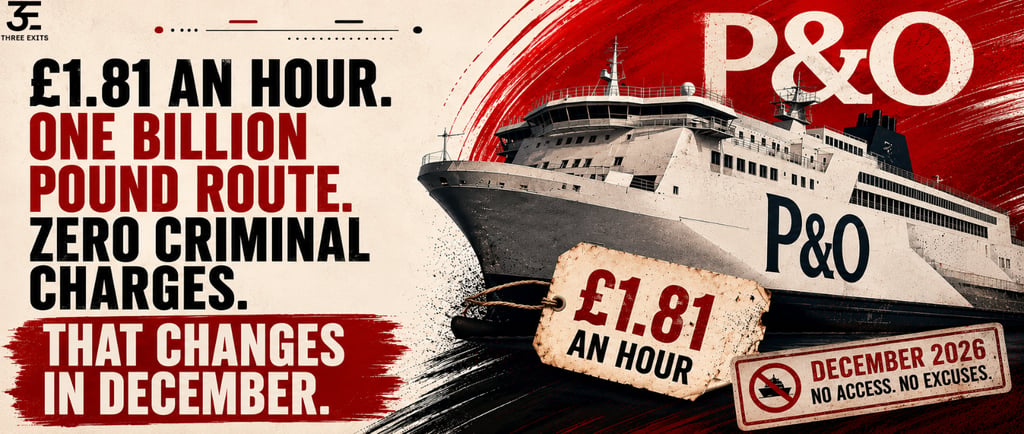
2022: P&O fired 786 staff and paid crew wages of £1.81 an hour. Zero criminal charges.
In December 2026 a new law lands. P&O is currently the only major Channel operator that can't pass it.
Read time: 5 minutes
____________________
The Setup
On the morning of 17 March 2022, 786 seafarers were told their employment was terminated with immediate effect. They received the news by pre-recorded video, played while their ships were ordered back to port.
Private security staff were waiting dockside.
Peter Hebblethwaite, P&O’s chief executive, told a parliamentary select committee three days later that the company had known the dismissals were unlawful.
There was no consultation, no notice to the UK government, no collective redundancy process. He explained that P&O had calculated the legal exposure in advance and concluded the cost of compliance outweighed the cost of breach.
Zero criminal charges followed.
The settlement cost P&O £36.5 million. The annual labour saving was £21.3 million. Some replacement crew were paid £1.81 an hour.
On the arithmetic Hebblethwaite was measuring, the decision worked.
Hebblethwaite modelled legal exposure. He knew what it would cost in court. He didn't know what it would cost in 4 years time.
____________________
The Playbook
1. Three decisions
P&O’s Dover-Calais operation was loss-making against competitors running cheaper crew models. Irish Ferries was structurally more competitive on the same route. The gap was labour cost.
The restructuring addressed that gap through three decisions.
Ships were flagged in Cyprus, Bermuda and the Bahamas rather than the UK.
Replacement crew were contracted through an agency incorporated in Malta roughly six weeks before the dismissals.
Crew were domiciled outside the UK.
Each decision was independently defensible. Combined, they placed the entire workforce outside UK employment protections. No pension obligations. No statutory maternity leave. No UK minimum wage. No collective redundancy process. Wages could fall to £1.81 an hour because no UK law could protect the employees.
The mechanism that made it legally possible was a drafting error in 2018 legislation.
A 2018 amendment replaced the duty to notify the UK government about mass redundancies with a duty to notify the ship’s flag state instead. But the criminal penalty in the original Act was never updated to follow.
P&O notified the flag states. The UK government found out when the video went out. The criminal investigation opened in March 2022 and closed in August with no realistic prospect of a conviction.
Hebblethwaite told parliament he knew it was unlawful. He said it without apology. The criminal exposure had been priced in before the video was recorded.
____________________
Takeaway: Every legal team can tell you what a breach costs. Almost none of them can tell you what happens when the CEO explains the breach on live TV. That is not a legal question. It is a governance question. And most companies have nobody whose job it is to answer it.
____________________
2. How £1.81 an hour became a legislative gift
The £1.81 figure was confirmed by RMT in March 2022 from internal P&O management correspondence. Hebblethwaite disputed it in committee, citing an all-in average of £5.15 across routes. The £1.81 referred specifically to Indian crew on the Dover-Calais route. Both figures were sourced.
By May 2024, Hebblethwaite told a committee that some crew were being paid £4.87 an hour all-in. When asked whether he could live on that wage, he said no.
The Seafarers’ Wages Act received Royal Assent in March 2023.
France passed equivalent legislation in 2024.
The UK Employment Rights Act 2025 doubled the protective award for unlawful collective dismissals and tightened the collective redundancy rules.
Full Charter compliance becomes a harbour-access condition in December 2026.
Two countries wrote new law because of one company’s decision.
The decisions that trigger legislation share recognisable characteristics. They are technically legal. They affect a visible workforce rather than an abstract process. The economics compress into a number a journalist can put in a headline. The CEO is willing to explain that number in public.
P&O had all four. A wage of £1.81 an hour is not a compliance technicality. It is a headline. It is the kind of number that makes a transport select committee feel obligated to act.
A fine gets paid once. A law sits on the cost base permanently.
____________________
Takeaway: Fines get paid and forgotten. Laws sit on the cost base forever. The difference for P&O is one select committee appearance.
____________________
3. The £1.81 compliance trap
The June 2026 Charter assessment confirmed that P&O passes eight of nine sections. The section it fails covers social welfare: pensions, maternity provision and crew welfare standards.
It cannot be fixed with a policy update.
The contract structure that produced £1.81 an hour is the same contract structure that fails the welfare assessment.
They are not separate problems.
The Maltese agency model, the flag jurisdiction and the offshore domicile are what keep labour costs down. They are also what the welfare standards are specifically designed to address.
Remove them and the 2022 saving disappears. Keep them and December 2026 gives harbour authorities at Dover the power to turn the ships away without a judge.
DFDS, Brittany Ferries and Stena Line all passed in full. P&O is the only major operator that has not.
December 2026 is not a compliance deadline in the ordinary sense. It is the moment harbour authorities can deny access to any service that cannot produce a satisfactory Charter declaration.
No court process. The harbour master at Dover can refuse entry.
DP World has poured more than £440 million in shareholder loans into P&O since the restructuring. The group has never publicly indicated it intends to rebuild the crew model.
That silence is a bet: that regulators will not use the powers parliament handed them and that Dover needs P&O more than P&O needs to reform.
December 2026 is when that bet gets called.
____________________
Takeaway: When your only compliance strategy is "they need us too much to enforce it," you are not managing risk. You are making a political bet with your operating licence as the stake.
____________________
What Gets Missed
The most unusual part of this story is not that P&O broke the law. It is that the CEO sat in front of parliament and explained exactly how.
On 24 March 2022, eighteen days after the video, Hebblethwaite told the Transport Select Committee the precise mechanism.
He confirmed there had been no consultation. He confirmed the company had known it was unlawful. He confirmed the calculation: legal exposure priced, settlement prepared, video recorded. He defended, apologising for the method. He stood by the decision.
He did not have to say any of that. He said it anyway.
Parliament did not need an investigation. The CEO had just provided the evidence base on the record, in public, with a number attached that any transport secretary could read in a headline.
The Seafarers’ Wages Act was drafted on that testimony. The French legislation followed. The Employment Rights Act 2025 tightened the rules further.
The Charter compliance framework that P&O now cannot pass was built specifically around the practices Hebblethwaite described and defended across multiple committee appearances over three years.
His testimony was not just politically damaging. It was the primary source document for four years of legislation.
Most coverage treats March 2022 as a corporate governance failure. It was.
The more instructive failure is the governance gap that produced the committee appearance: Nobody asked what happens when the CEO explains the mechanism to the people who write the laws.
Legal teams are built to manage court risk. That is a different question from: what happens when the CEO converts a defensible legal position into a public record that parliament can legislate from?
The standard lesson from P&O is: don’t use a legal classification to suppress wages.
The more transferable lesson is: a cost structure built on legal classification becomes a legislative target the moment it is visible, defensible and attached to a number.
Software companies use contractor classification to cut national insurance. Retailers use returns processing arrangements that work until a journalist runs the numbers.
The mechanism is the same. It works until it becomes visible at scale, at which point the response is not a fine. It is a law.
The decision made sense in March 2022. The fine was manageable. The settlement was paid. The route kept running. What nobody modelled was parliament. Four years later the law they wrote is the cost base. The fuse was lit in the committee room, not on the ship.
____________________
The Paper Trail
FRC audit probe into P&O accounts
1 minute read
The FRC has opened an investigation into an individual linked to P&O's 2020–2022 accounts. Four years after the sackings, the numbers that underpinned the whole restructuring story are now under formal regulatory scrutiny.
https://www.cityam.com/po-ferries-to-be-probed-over-possible-audit-failings/
____________________
Losses widen four years on
1 minute read
P&O's 2024 accounts show a £99m loss and falling turnover, despite the £21.3m annual saving on labour. The cost restructuring worked on paper. The business still bleeds cash. That gap is the whole story.
https://www.itv.com/news/2026-01-15/losses-at-p-and-o-ferries-widen-four-years-after-mass-sackings
____________________
Mandatory Seafarers' Charter factsheet
3 minute read
The Charter becomes legally binding in December 2026. Harbour authorities get enforcement powers equivalent to the Seafarers' Wages Act. What was an optics problem for P&O becomes a hard access risk at Dover.
____________________