
Thames Water:
£2.7 billion stripped out. Sixteen million captive customers. No competitor. Three weeks from running out of cash.
ALL BREAKDOWNSTHE BREAKDOWN
7/9/20264 min read
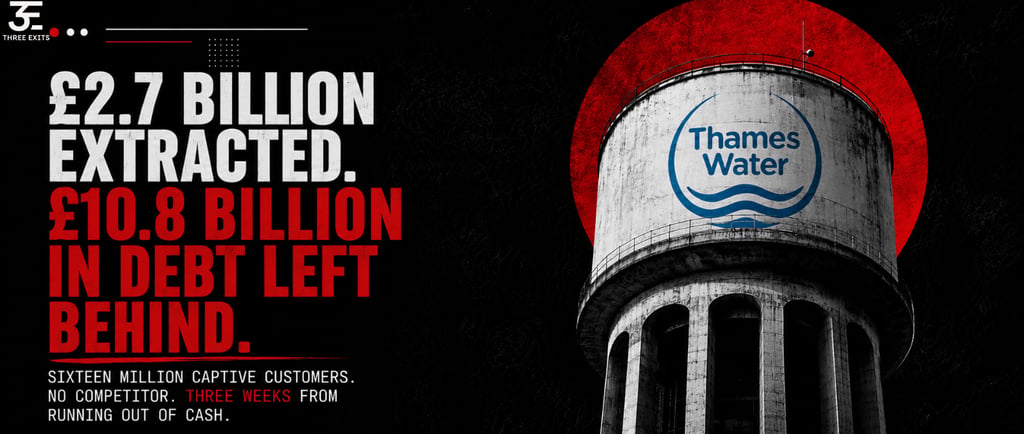
£2.7 billion stripped out.
£10.8 billion in debt left behind.
Sixteen million captive customers. No competitor. Three weeks from running out of cash.
____________________
THE SETUP
Macquarie, an Australian infrastructure investor, led a consortium that bought Thames Water in 2006 for an £8.5bn enterprise value and installed David Owens as CEO.
That deal is still being fought over. Thames Water now owes £20bn.
In June 2026 creditors offered a £10bn rescue plan. The government rejected it, saying it failed to protect customers. 107 MPs want Ofwat to force special administration instead.
The deal came with £3.6bn of debt sitting above the regulated company. Ofwat had promised that debt would stay ring fenced from customers.
Owens ran the business to service that debt first. Investment came after.
Regulators and investors saw a boring regulated utility with guaranteed revenue and no competitors.
Underneath, the debt climbed every year and cash moved out the door faster than pipes were replaced.
Macquarie had banked its return long before anyone noticed. Nobody who built the debt was still in the business when it came became due.
____________________
THE MOMENT
February 2025. Thames Water tells the High Court it will run out of cash within weeks.
A judge approves a £3bn emergency loan just to keep the taps running. Chris Weston, the CEO brought in to manage the wreckage, wasn't in the business in 2006.
Macquarie had sold its last stake back in 2017, to a group of pension funds and sovereign wealth funds including OMERS and the Kuwait Investment Authority.
The debt kept climbing after they left. By 2024 it neared £18bn and Ofwat placed the company into special measures. By 2026 it had grown to £20bn.
Weston inherited the wreckage. Macquarie was gone. The debt was still there.
Engineers were still patching Victorian pipes on the same maintenance budget while lawyers argued over whether the company could survive the month.
Some of that debt had never really left the business. Thames Water raised its own debt against its pipes and treatment works, the same assets Ofwat lets it earn guaranteed revenue on and used part of it to help repay the loan Macquarie had used to buy the company.
The company ended up funding the sale of itself.
____________________
The numbers (2006–2025):
Enterprise value: £8.5bn (2006 Macquarie-led buyout)
Extracted under Macquarie: £2.7bn (£1.1bn to shareholders, rest into debt service)
Debt growth: £3.6bn to £10.8bn, 2006 to 2017 (gearing passed 80%, against Ofwat's sector benchmark nearer 60%)
Debt by 2024: £18bn, the year Ofwat placed the company into special measures
Court-approved emergency loan, February 2025: £3bn
Ofwat penalty, May 2025: £122.7m, the largest ever issued to a UK water company
Debt by 2026: £20bn, against a £10bn rescue plan the government rejected in June
Revenue never dropped. The company nearly collapsed anyway.
____________________
THE PAYBOOK (That’s not a typo)
1. The buyout that financed its own exit
→ Lenders keep lending against a regulated asset base because the bills are guaranteed no matter who owns the business.
→ Macquarie raised debt at the top of the structure and pushed it down onto the regulated company, then used part of that borrowing to repay its own acquisition loan.
→ The ring fence Ofwat required in 2006 was meant to stop exactly this. Nobody stepped in until Thames Water was already refinancing its buyer's exit with money borrowed against its own pipes.
→ Ownership changes every few years. The debt and the arrangement that created it, stays behind on the regulated company.
____________________
2. Selling before the bill comes due
→ Pension funds and sovereign wealth funds want long duration assets that pay steady income for decades and a water monopoly with a fixed customer base looks exactly like that.
→ Macquarie sold its stake in 2017 to OMERS and the Kuwait Investment Authority, among others, once its own return was already banked.
→ Eight years later the same structure needed a court approved £3bn rescue loan just to stay solvent.
→ The buyers inherited a capital structure built to fund Macquarie's exit, not their own thirty year horizon.
____________________
3. A captive customer can't fix a bad structure
→ In a competitive market, customers leave first and the balance sheet gets fixed or the business dies. Thames Water's sixteen million customers had nowhere else to go, so revenue held up the entire decade the debt was building.
→ Without that early warning, the debt ran until it nearly broke the company regardless of demand. Most of the £122.7m Ofwat fine wasn't even for the debt. £104.5m was for sewage spilled on ordinary days, not during storms. £18.2m was for paying dividends the company wasn't supposed to pay at all.
→ Customer bills rose by around 31% in 2025 under Ofwat's price settlement, with some unmetered households facing increases nearer 50%.
→ The same sixteen million who never chose the buyout are the ones paying it down.
____________________
THE CLOSE
Macquarie's numbers worked exactly as planned. £2.7bn came out and debt tripled before they sold up in 2017. All of it happened on schedule and inside the rules.
Seven years later the company nearly went under and demand had nothing to do with it. The people who built the debt were long gone by the time it became due.
Twenty years on, the fight over who pays is still running and the most likely next owner is the state.
Thames Water was a debt-funded buyout that happened to supply water to sixteen million people.
____________________