The Body Shop
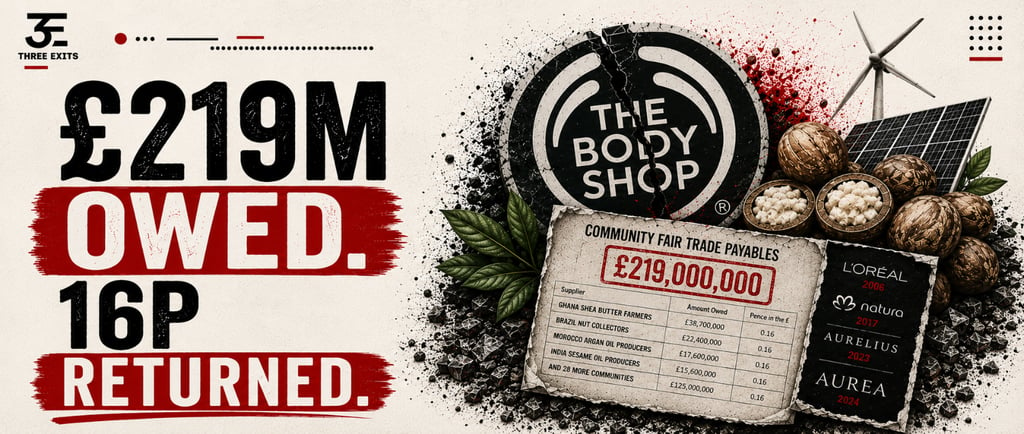
The Body Shop owed its suppliers £219 million. They got 16p in the pound. The 2026 sustainability plan commits to "people and communities."
ALL BREAKDOWNSTHE BREAKDOWN
6/18/20265 min read
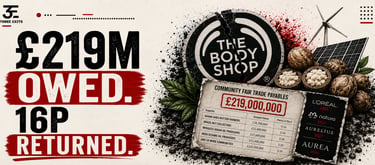
The Body Shop just published a 25-year sustainability plan.
The suppliers who built it lost £219 million.
____________________
THE SETUP
In May 2026 The Body Shop published a sustainability roadmap. Three pillars. People and communities. Nature and biodiversity. Climate and circularity.
Peter Wood agreed to buy The Body Shop with £3.5 million at risk.
That decision, taken on 14 November 2023, is what the sustainability plan is built on top of.
The total creditor exposure in the business Wood was acquiring was £276 million. The Community Fair Trade suppliers who had spent decades making The Body Shop’s ethical reputation credible were in that number.
When the business entered administration eleven weeks later, they recovered 16 to 27p in the pound on £219 million owed.
Wood left Aurelius within days of administration being declared. The Telegraph named him as the “dealmaker behind disastrous Body Shop buyout.” He departed without public comment.
Tristan Nagler, Partner and Head of Aurelius Investment Advisory, had signed the deal. His statement on announcement day described Aurelius as “delighted to be undertaking this acquisition of an iconic British brand which pioneered the cruelty-free and natural ingredient movement.”
Six weeks later the UK entity was in administration.
The £207 million headline price and the £3.5 million upfront were both in the public domain on the same day. Nobody put them next to each other.
____________________
THE PLAYBOOK
1. £3.5 million at risk on £276 million in exposure
The acquisition price was £207 million. Aurelius paid £3.5 million upfront. The remaining £203.5 million was contingent on a turnaround.
This is standard in distressed acquisitions. The buyer pays a base price upfront and defers the rest against performance targets. Done carefully, it aligns incentives. The more the business recovers, the more the deferred consideration is worth. The buyer has a reason to make it work.
Wood’s version did not work that way.
A buyer with £207 million of real cash committed to a distressed business has a direct reason to stabilise suppliers, refinance debt and protect the trading relationships the brand depends on. Their money is inside the thing they are trying to save.
A buyer with £3.5 million upfront on £276 million in creditor exposure has a different position. They lose £3.5 million if it goes wrong. The creditors lose the rest.
Aurelius failed to refinance a HSBC loan. The UK entity entered administration in February 2024. The Community Fair Trade suppliers recovered less than a quarter of what they were owed.
The downside was not shared equally.
____________________
Takeaway: The gap between the headline price and the upfront commitment tells you how much a buyer actually believes in the deal. Read them both before you sign anything with them.
____________________
2. The ethical reputation was the asset.
L’Oreal paid £652 million for The Body Shop in 2006 and promised to ring-fence the ethics. Natura paid £880 million in 2017 and published a Commitment to Life plan. UK revenue fell 26.3% in a single quarter in 2022. By August 2023 Natura was looking for a buyer.
Each owner paid a premium for the gap between what the ethics cost to run and what the reputation was worth at sale.
The Community Fair Trade suppliers were the cost. When owners reduced that cost, they were not cutting overhead. They were extracting the value the suppliers had built, year after year, without compensating them for it.
Wood’s acquisition was the same trade with almost no equity behind it. Which meant when it went wrong, there was nothing between the suppliers and the collapse.
____________________
Takeaway: The question to ask any new owner is not what they plan to do. It is how much the ethics cost to run annually and whether that number is in the budget. If they cannot answer it, they are buying the reputation, not running it.
____________________
3. The brand exits clean.
UK insolvency law treats brand equity as a transferable asset. The IP, the trading name and the goodwill move to whoever buys them out of administration. The debts stay in the old company.
Aurea bought 113 stores and The Body Shop brand out of administration in September 2024 for a minimum of £44.3 million. It acquired the Roddick story, the Community Fair Trade heritage and fifty years of ethical positioning.
The £219 million owed to unsecured creditors was not part of the transaction.
The suppliers who built that heritage were behind HMRC and behind the secured lenders. They got 16 to 27p in the pound.
Aurea declared the business profitable within 100 days, relocated headquarters to Brighton and published the 25-year sustainability plan.
Several Community Fair Trade suppliers said they would work with The Body Shop again. The brand name that failed them still carries more weight than any alternative buyer could offer.
____________________
Takeaway: In administration, the ethical reputation transfers with the brand. The ethical obligations stay with the creditors. That gap is visible before the deal closes. In this case it was visible on day one.
____________________
WHAT GETS MISSED
The 2026 sustainability roadmap has been covered as a reset story. New ownership. Brighton. Roddick’s values. Twenty-five years of commitment.
The coverage did not mention that the people named in the plan are the same people who got 16p in the pound.
The piece that would have changed everything is simple. On 14 November 2023, two numbers were published simultaneously. £207 million acquisition price. £3.5 million upfront. The question those two numbers raise is not complicated: what happens to the £276 million in creditor exposure if the turnaround fails and the buyer has £3.5 million at risk?
The answer was visible before Wood signed.
The shea butter farmers, the organic producers, the Community Fair Trade partners across four continents were in the marketing materials. They were in the annual reports as proof the ethics were real.
They were the cost that made the reputation worth £207 million to announce and £3.5 million to actually commit.
The new plan commits to the same communities. The question is whether Aurea has put the annual cost of running those commitments into the budget. That figure is not in the roadmap. It hasn’t been made public.
The suppliers who built the reputation behind the new plan are still waiting for their money from the last one.
____________________
THE PAPER TRAIL
The 2026 Sustainability Roadmap
3 minute read
The only published interview with Head of Sustainability Breanna Lujan confirming the three pillars of the plan: people and communities, nature and biodiversity, climate and circularity. Includes the 2050 net zero target and the commitment to revive Roddick's refill programme.
The Body Shop reset: Retailer to unveil 2026 sustainability roadmap — Premium Beauty News, 17 May 2026
____________________
The creditor shortfall
4 minute read
Based directly on the FRP Advisory creditors' report. Confirms the 16 to 27% recovery rate on £219 million owed, names Children on the Edge, MindOut and Ecocert among the unsecured creditors, and confirms Auréa paid a minimum of £44.3 million for the brand. Aurelius received nothing.
The Body Shop's suppliers to receive no more than a quarter of £219m owed — The Guardian, 20 March 2025
____________________
The full liability stack
4 minute read
Based on the FRP administrator report from April 2024. Breaks down the £276 million in total creditor exposure: £143 million intercompany, £63 million lease and borrowings, £44 million trade creditors, £6.3 million HMRC. Names Avon as the largest single trade creditor at over £13 million.
The Body Shop owed more than £276m to creditors at time of collapse — The Guardian, 5 April 2024
____________________