
Thomas Cook
Fosun offered £450m to rescue Thomas Cook. The rescue failed. Six weeks later Fosun bought the brand for £11m. The collapse saved them £439m.
ALL BREAKDOWNSTHE BREAKDOWN
6/9/20266 min read
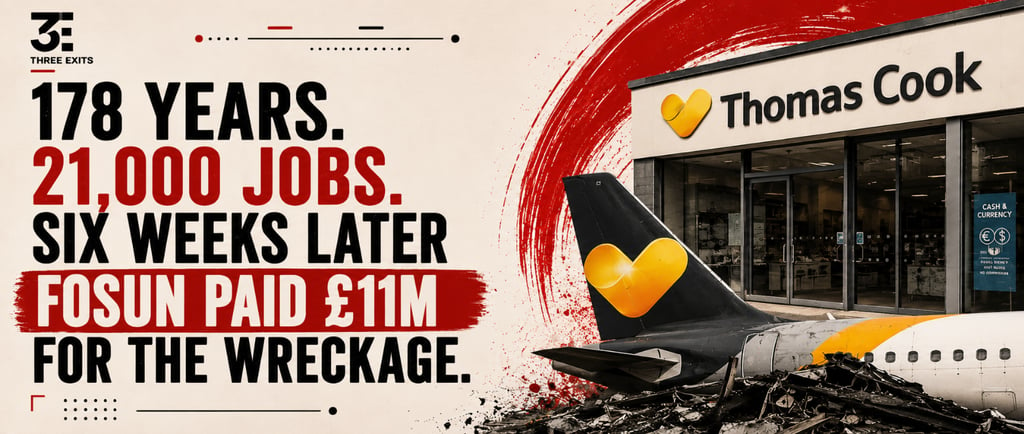
Fosun offered £450m to rescue Thomas Cook.
The rescue failed.
Six weeks later Fosun bought the brand for £11m.
The collapse saved them £439m.
___________________
THE SETUP
Thomas Cook posted £9.6 billion in revenue in 2018. Fourteen months later it collapsed at 1.47am on a Monday morning. Six hundred thousand customers were stranded. Twenty-one thousand jobs were gone.
A rescue had been on the table. Fosun International, Thomas Cook's largest shareholder, agreed to put in £450m. The lending banks would put in another £450m. Creditors would write off £1.7bn in existing debt. The deal was largely done.
Then the banks came back for more. They wanted an additional £200m winter standby facility before they would sign. Thomas Cook didn't have it and asked the government to guarantee it. The government refused.
The company collapsed four days later.
Six weeks after the collapse, Fosun bought the Thomas Cook brand from administration for £11m. No debt. No pension deficit. No 500 stores. No airline.
Fosun had spent four years calling Thomas Cook a strategic platform for Chinese outbound tourism. It turned out what it actually wanted was the name.
Most coverage blamed the banks, the government, the debt.
One party in the rescue room had a specific reason to want the rescue to fail. It got exactly what it wanted.
The numbers are all public. Draw your own conclusion.
___________________
THE PLAYBOOK
1. Fosun: Rescue vs Administration
Fosun took an 18% stake in Thomas Cook in 2015. From day one, Fosun CEO, Guo Guangchang described it as a brand play. His words: "good brand recognition" that would "further develop international leisure tourism." He was never talking about running a tour operator. He was talking about a name.
The rescue package would have given Fosun 75% of the tour operation and 25% of the airline. A controlling stake in a restructured group still carrying converted debt, a pension deficit requiring more than £25m in annual contributions, 500 high street stores and a fleet of aircraft Fosun had no experience running.
Into a business whose own management had admitted the previous year that the strategy had not been implemented quickly enough.
Administration gave Fosun the trademarks, the domain names, the hotel marques and the social accounts for £11m. No debt. No pension. No stores. No aircraft.
The only other buyer with scale to want the Thomas Cook name said it did not want to own it outright. No competing bids came in higher.
The Hong Kong Stock Exchange filing Fosun submitted in November 2019 describes the acquisition as something that "will enable the Group to expand its tourism business building on the extensive brand awareness of Thomas Cook."
There is no mention of the tour operation, the airline, the pension or the stores.
Fosun needed the brand. The rescue bundled it with a decade of accumulated liabilities.
Administration sold it alone for £11m.
___________________
Takeaway: When one party in a rescue negotiation can get what it actually wants through failure, watch how hard they push for the deal to close.
___________________
2. £200m was never going to save the business
The 2007 MyTravel merger handed Thomas Cook a debt load it never worked off. Net debt sat at roughly £1.25bn across 2014, 2015, 2016, 2017 and 2018.
Five years of reported turnaround. The debt line barely moved.
The company paid £1.2bn in interest over eight years, more than 25% of the revenue generated from 11 million holidays.
Management ran digital initiatives and restructuring programmes throughout. The capital structure stayed fixed.
The business ran a seasonal model: money made in summer, burned through every winter paying aircraft leases, hotel contracts and staff costs while bookings dried up.
The banks had financed that cycle for years.
In mid-September 2019, with the £900m rescue largely agreed, RBS and Lloyds returned with a new condition. They wanted the additional £200m winter standby facility before they would sign.
Their position was direct: they did not trust the business to survive the next four months and they were not absorbing that risk alone.
Thomas Cook asked the government to guarantee it.
By 2019, the half-year loss was £1.46bn.
Thomas Cook CEO, Peter Fankhauser's own advisors concluded the company would run out of cash by 4 October, eleven days after it went into liquidation.
Business Secretary Andrea Leadsom told Parliament that £200m was itself an underestimate of the real requirement. Birmingham Business School's post-mortem concluded any investment would have been absorbed in days.
The £200m debate was never about saving Thomas Cook. The company was already going down. The argument was about who absorbed the loss when it landed.
The banks needed the rescue to work. A going-concern restructuring preserved the value of £1.7bn in debt.
Liquidation meant a fire sale.
They had every incentive to close the deal.
Fosun held equity. Equity in a liquidation is worth nothing.
The administration process was the only mechanism that could separate the brand from every liability attached to it.
___________________
Takeaway: When a business is in trouble, the people offering to help are not all trying to save it. Some of them are positioning for what comes after.
___________________
3. The government refused £200m and then spent £156m on the aftermath
Thomas Cook formally requested a government guarantee of £150m to £250m on 18 September 2019. The government refused on 22 September.
The National Audit Office established that the CAA began enhanced monitoring of Thomas Cook in September 2018, a full year before the collapse.
The Department for Transport began contingency planning in April 2019.
By July 2019, a cross-government steering board for repatriation was in place.
On 17 September 2019, HM Treasury and the Prime Minister approved the repatriation plan.
Thomas Cook's formal request arrived the following day.
On 22 September, Foreign Secretary Dominic Raab told the BBC the government had "dozens of charter planes on stand-by, ready to fly customers back home free of charge if the travel agent collapses." The rescue negotiation was still live when he said it.
The government was not weighing rescue against collapse on 18 September. It had already made that call. The request landed on a desk where the answer had been decided the day before.
Operation Matterhorn ran 1,035 repatriation flights, brought 150,000 passengers home from 54 airports using 130 aircraft sourced from 50 airlines.
Total cost: at least £156m.
The government also underwrote two uncapped contingent liabilities to keep Thomas Cook's systems running long enough to manage the booking data.
The NAO declines to assess whether the refusal was the right decision. The timeline is harder to explain.
___________________
Takeaway: Refusing to fund a rescue does not eliminate the cost. It transfers it. The question is always who pays, not whether anyone does.
___________________
WHAT GETS MISSED
Three parties sat in the Thomas Cook rescue negotiation. Each one wanted a different outcome.
The banks held £1.7bn in debt. Their best outcome was a going-concern restructuring. Liquidation meant a fire sale and years of recovery. The banks needed the rescue to close.
The government held the guarantee that could make the deal work. The NAO timeline shows the repatriation plan was approved the day before the formal rescue request arrived.
The government was not choosing between rescue and repatriation at that point. It had already chosen.
Fosun held equity. The rescue delivered the liabilities with the brand. Administration delivered the brand without them.
The Hong Kong filing is the clearest statement of what Fosun actually wanted and it reads nothing like the rescue package that was on the table.
A deal requires all parties to want it to close. Two of the three parties in this room had reasons not to.
EasyJet paid £36m for Thomas Cook's Gatwick and Bristol landing slots. Hays Travel paid £6m for 555 high street stores and hired 400 former staff. Fosun paid £11m for the brand Guo Guangchang had spent four years describing as the strategic prize.
The government spent £156m on the collapse. It had refused £200m to prevent it.
The 21,000 employees got the phone call. Operations had paused. Unpaid. Use your annual leave.
Fosun got the brand for £11m. It had offered £450m for the whole thing. The numbers are public. The filing is public. The outcome is public.
___________________
THE PAPER TRAIL
Birmingham Business School: Why Thomas Cook collapsed, October 2019
3 minute read
The blog of the post-mortem on whether £200m would have saved the business. Its conclusion that any investment would have been absorbed in days reframes the final negotiation as a dispute about who absorbed terminal losses rather than whether they were avoidable. The £1.2bn interest figure is the one worth keeping.
https://blog.bham.ac.uk/business-school/2019/09/26/thomas-cook/
___________________
Fosun International: Thomas Cook brand acquisition, November 2019
5 minute read
The Hong Kong Stock Exchange filing in which Fosun states the company ‘always believed in the brand value of Thomas Cook.’ Read alongside the August 2019 rescue structure to understand which liabilities Fosun shed between the two transactions. The gap between those two asset lists is the story.
https://www.tourmag.com/attachment/1762888/
___________________
NAO investigation – indemnities + planning detail
15 minute read
For the legal/financial detail on the two uncapped government indemnities and the timing of contingency planning, this is the key document:
National Audit Office – Investigation into government’s response to the collapse of Thomas Cook:
https://www.nao.org.uk/wp-content/uploads/2020/03/Investigation-into-governments-response-to-the-collapse-of-Thomas-Cook.pdf
___________________