Topshop
£330m to buy Topshop. Every one of its 70 stores rejected.
ALL BREAKDOWNSTHE BREAKDOWNFEATURE
7/14/20267 min read
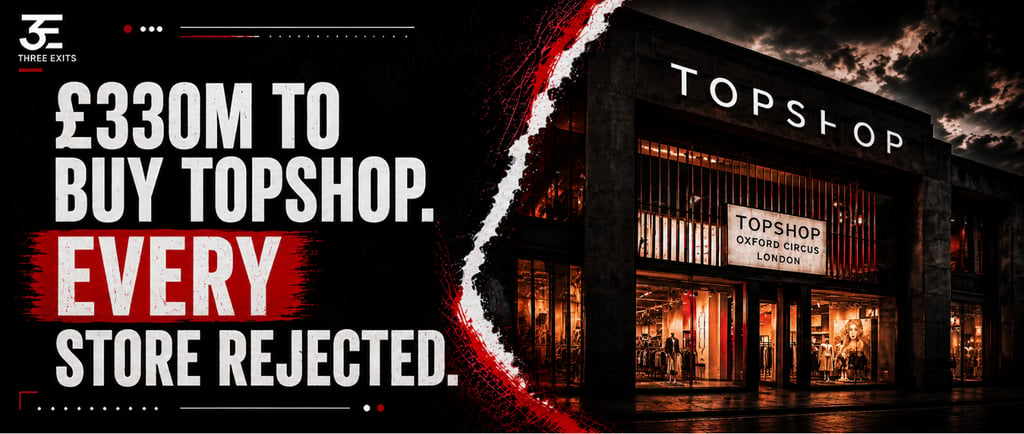
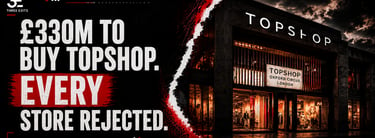
£330m to buy Topshop. Every one of its 70 stores rejected.
Five years later, ASOS pays John Lewis rent just to put Topshop clothes on a shelf again.
That's the £330m mistake ASOS are still paying to fix.
Read time: 6 minutes 30 seconds
____________________
THE SETUP
Topshop collapsed because Arcadia was still running it like a business from the 2000s. Zara, Boohoo and Shein had already rebuilt fashion retail around speed. Arcadia hadn't.
Five years after the last store closed, the same mistake happened. Arcadia's management looked at the Oxford Circus flagship and saw an expensive shop.
That store had opened in 1994 with a DJ booth and a nail bar and for years it was the store every other retailer measured itself against. That store was the reason people still thought Topshop was exciting.
ASOS's board looked at the store and saw a cost, not a reason to promote the brand. That's the mistake: both companies could see what the store cost to run, but neither one could see what it was doing for the brand. ASOS's whole deal was supposed to be the fix for Arcadia's mistakes, not a repeat of the biggest one.
Arcadia collapsed into administration in November 2020, putting 13,000 jobs at risk. In February 2021, ASOS paid around £330m for the Topshop, Topman, Miss Selfridge and HIIT brands.
It didn’t buy the 70 stores or take on the 2,500 staff working in them. By September 2024, ASOS had sold 75% of Topshop and Topman to a Danish rival and was now paying royalties just to keep selling brands it used to own outright. By February 2026, Topshop was back on the high street, renting shelf space inside 32 John Lewis stores.
ASOS says the relaunched topshop.com will grow more than 1,100% by the end of 2026. That sounds big, but it's growing from only $9m in 2025. A small number growing fast is still a small number.
ASOS never worked out what that shop space was actually doing for the brand. Three years later, that mistake caught up with them.
____________________
THE PLAYBOOK
1. Oxford Circus
Under Philip Green, Topshop ordered stock four to six months in advance, mostly from factories in Asia, in two big seasonal batches a year. By the time that stock arrived, trends had often moved on, but the order was already placed and paid for, so it went on the shop floor regardless.
Zara ran the opposite model, keeping most production close to its Spanish and Portuguese factories in small batches, so a design could go from sketch to shop floor in four to six weeks and get reordered fast if it sold.
Boohoo and Shein skipped physical stores altogether. They uploaded thousands of new styles online every week and let real-time clicks decide what got made in bulk, with no till, no rail and no store lease to fund.
Topshop was slower than Zara and more expensive to run than Shein.
Arcadia's market share fell from 4.5% to 2.7% between 2015 and 2020. The group posted a £138m operating loss in 2018, its first in seven years, against roughly £750m of debt and a £537m pension deficit.
But the flagship that made Topshop's cost base heavy was also generating demand no marketing budget could buy. Oxford Circus had run a DJ booth and a nail bar since 1994.
The 2007 Kate Moss collaboration brought queues around the block and made the front pages. That one launch showed what the store could do: turn people showing up into constant demand and keep Topshop part of the conversation in fashion.
Zara solved for speed. Shein solved for cost. Topshop's flagship solved for attention and attention was the one thing Arcadia never valued.
____________________
Takeaway: A shop can be a cost and a marketing tool at the same time. Before you decide it's not worth keeping, work out which job it's actually doing. Arcadia and ASOS both measured what the store cost. Neither one measured what it was worth in attention.
____________________
2. Buying the brand
When Arcadia collapsed in November 2020, ASOS moved fast. In February 2021, chief executive Nick Beighton agreed to pay around £330m for Topshop, Topman, Miss Selfridge and HIIT: £265m for the brands and goodwill, plus roughly £65m for stock and forward orders.
The deal excluded the 70 leasehold stores and the 2,500 staff working in them. Beighton called running stores "not our model", and said keeping the Oxford Circus flagship was "not a priority." He was, in fairness, entirely consistent. ASOS had never run a physical store.
The logic held together on a spreadsheet. ASOS could plug Topshop's brand, design team and stock straight into its own warehouses, marketing and technology without carrying a single lease. The savings were immediate and easy to put a number on.
What the deal assumed was that ASOS's platform could reproduce the brand value and keep Topshop current.
YouGov's brand tracking says the assumption was wrong. Topshop's brand health score among 18 to 29 year olds sat at 12.4 six months before the takeover. By completion it had dropped to 8.8. By October 2023 it was 5.4.
Awareness barely moved the whole time, holding around 80 to 90 points. Buzz, YouGov's measure of whether people are hearing something good about a brand, fell from 0.3 before the deal to minus 12 at completion.
People still knew what Topshop was. They had stopped feeling anything about it. That problem wasn’t on the balance sheet. It was in a brand-tracking survey two years later, by which point the only fix left was expensive.
____________________
Takeaway: People knowing your brand and people caring about your brand are not the same thing. If you strip out what made people care, knowing your name won't be enough to keep the brand valuable.
____________________
3. Renting back what was given away
By 2024, ASOS itself was in trouble, with pre-tax losses of around £120m in the first half of the year alone. In September, it sold 75% of Topshop and Topman to Heartland, the investment vehicle of Bestseller owner Anders Holch Povlsen, in a joint venture valuing the brands at £180m.
Heartland was not a random buyer. Bestseller runs Vero Moda, Jack & Jones and Only, three brands built on the exact wholesale and physical distribution relationships ASOS had spent three years without.
It already had the buyers, the store relationships and the logistics Topshop needed back. ASOS had the brand and the design team. Neither business had both halves on its own, which is precisely why the deal was structured as a joint venture rather than a straight sale.
ASOS took £135m in cash for its balance sheet. It kept a 25% stake and held on to design and distribution rights for a royalty fee expected to cost £10m to £20m a year in profit.
Giving up majority control cost ASOS very little, because the majority it gave up was the one function ASOS had never been any good at running. The royalty was the only part of the old model worth defending.
The second admission came the following year. In April 2025, chief executive José Antonio Ramos Calamonte said Topshop would relaunch its own website and return to the high street through wholesale partnerships rather than owned stores. By September, that was John Lewis.
Topshop shop-in-shops opened across 32 stores from February 2026, almost five years to the month after the last Topshop store closed.
Topman followed into six or seven stores. John Lewis managing director Peter Ruis called the brands ones of "enormous cultural relevance" that had "defined our high streets."
None of this gives ASOS ownership back. It only gives them access and they're now paying for that access three separate times:
once to Heartland for the joint venture
once to John Lewis and Nordstrom for shelf space
once more to themselves, in the form of a royalty on a brand they used to own outright.
Arcadia had that shelf space for free until 2020. ASOS gave it up in 2021. By 2026 it was paying John Lewis and Nordstrom rent just to get some of it back.
____________________
Takeaway: Selling off a capability doesn't make it disappear. Someone else owns it now. If you need it back, you're renting it from them, on their terms, for as long as they'll let you.
____________________
WHAT PEOPLE MISS
Most coverage of the John Lewis deal treats it as sentiment, a much-loved British brand finally coming home.
Whether this actually works depends on what "working" means.
As a way to keep Topshop's name alive cheaply, it works. ASOS carries no lease, no store staff, no stock risk. As a way to rebuild what Topshop actually was, it probably doesn't.
A shop-in-shop inside John Lewis depends on interest from John Lewis's customers. It has no separate reason for anyone to visit, no flagship, no event, nothing that makes headlines the way Oxford Circus once did.
The $9m starting point for the relaunched website tells you the real size of what's come back. It's a small, low-risk presence, not the business Topshop used to be.
In hindsight, there's a cheaper version of this story that never got tested.
If ASOS had kept one flagship store in 2021, instead of walking away from all 70, it's likely Topshop's brand health would never have fallen as far as it did.
One store, run properly, was doing the job that made people care. Losing all of them at once is what let the brand go quiet. A single store would have cost far less to run than the three separate deals it took, across five years, to buy partial access back.
The choice ASOS made in 2021 wasn't between keeping everything and keeping nothing. It was framed that way at the time because it made the numbers simpler. The real choice was between an expensive full estate and a much cheaper partial one. Nobody appears to have costed that middle option before the stores closed for good.
____________________
THE PAPER TRAIL
YouGov: what's the remaining brand worth
4 minute read
The brand health data behind this piece. Read it to see the exact point where Topshop's awareness and its relevance stopped moving together.
____________________
Business of Fashion: ASOS buys Topshop sister brands in a $295 million deal
5 minute read
Beighton's own language on why the stores were excluded. Worth reading for how confident the logic sounded before the brand tracking data arrived.
____________________
Drapers: the factors behind Arcadia's collapse
6 minute read
The clearest account of the buying-cycle and store-cost mechanics that made Topshop unsustainable to run, before ASOS was ever involved.
https://www.drapersonline.com/insight/analysis/the-factors-behind-arcadias-collapse
____________________
ASOS plc: the wait is over, Topshop hits 32 John Lewis stores
3 minute read
The official announcement. Read it against the 2021 press release to see how far the language has moved from "not our model to operate stores."
____________________