
WH Smith
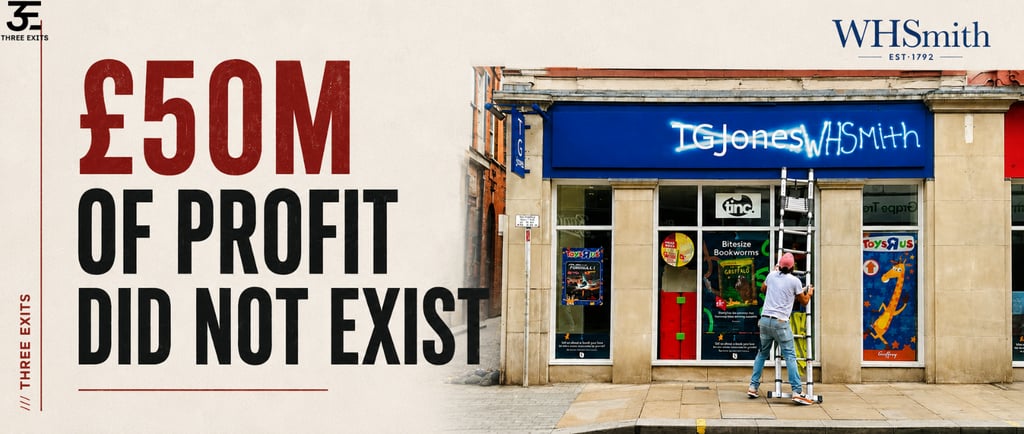
£50m of profit that didn't exist. One decision that left nowhere to hide. Here's what actually happened to WHSmith.
ALL BREAKDOWNSTHE BREAKDOWN
6/30/20263 min read
The share price fell 62% in under twelve months.
£50m of profit turned out not to exist.
WHSmith filed its annual report as ‘The Global Travel Retailer.’ Six months later it needed a £106m emergency cash raise.
____________________
THE SETUP
Carl Cowling became WHSmith’s group CEO in November 2019. His first day, the company completed a $400m acquisition of Marshall Retail Group in Las Vegas. Combined with InMotion, bought the year before for £155m, the deal doubled WHSmith’s international travel business overnight.
Cowling wanted one thing: a pure-play airport retailer. The UK high street was not part of it.
He executed that view over five years. No new high street stores. Sixty new travel locations a year. A stated target of 500 US airport shops.
In January 2025, WHSmith announced it was exploring a sale of the UK high street arm. By March, 480 stores and 5,000 staff had been transferred to Modella Capital for up to £40m.
The board approved every step. Analysts backed the pivot. In June 2025, investor Palliser Capital disclosed a 5% stake and called it “a high-quality, pure-play travel retail operator.” Not one major house flagged the concentration risk.
Then August 2025. WHSmith disclosed that its North American division had been booking supplier rebates too early for years. Profits overstated by up to £50m. The shares fell 42% in a day. Cowling resigned in November.
Cowling had bet everything on one channel. Then the channel broke.
____________________
THE MOMENT
November 2024. Cowling is interviewed by Retail Week. He has just announced 24 more US stores across Dallas, Denver and Washington. He says the goal is 500 shops in America and 20% of the US airport retail market.
He sounds like someone who has already won.
____________________
THE NUMBERS (FY2024–2026):
→ Revenue: £1.92bn in FY24
→ Travel trading profit: £202m — 85% of group total
→ Travel operating margin: ~14% (high street sector average: below 5%)
→ High street trading profit: £39m on £452m of revenue
→ North America profit: stated £55m. Reset to £25m after the accounting error
→ Share price: above £11 in summer 2025. £4.19 by June 2026
→ £1.5m in bonuses clawed back from Cowling and his CFO
____________________
THE PLAYBOOK
1. Life without the high street
→ Travel made £202m in FY24. The high street made £39m. On a spreadsheet the case for selling was obvious
→ A spreadsheet doesn’t show correlation. Every airport, rail hub and hospital store moved with the same variable: passenger numbers. The high street didn’t
→ Middle East conflict. Weaker consumer confidence. Three profit warnings in nine months
→ Every hit landed in the same place
____________________
2. The North America division was the growth story.
→ Cowling had committed publicly to 500 US stores and 20% of the American airport market. North America was the engine the whole strategy depended on
→ The division had been booking supplier income too early for years. Projected profit: £55m. Actual: £25m
→ Deloitte found a target-driven culture and a finance team not built for the scale it was being asked to operate at
→ The FCA opened a formal investigation. The shares fell 42% in a day. Cowling was gone by November
____________________
3. Two problems. One year.
→ The accounting error and the travel shock were unrelated. Different causes, different divisions, different timelines
→ In a business with more than one channel, you absorb one and manage the other
→ Expected profit: down to £75m–£90m. Dividend suspended. £106m raised just to stay standing
____________________
THE CLOSE
Cowling didn't just misjudge the future of travel. He mispriced the cost of putting everything else in the bin.
Once the high street was gone there was nothing left. The US accounting hole took £50m out of the model. The Iran war took another £20m off expected profit and killed the dividend. A business that called itself a high-quality pure-play travel operator had to sell 20% of itself at a discount just to stay solvent.
____________________