
X.com
Musk crashed X's revenue. What came next suggests it may not have been an accident.
ALL BREAKDOWNSTHE BREAKDOWN
6/4/20267 min read
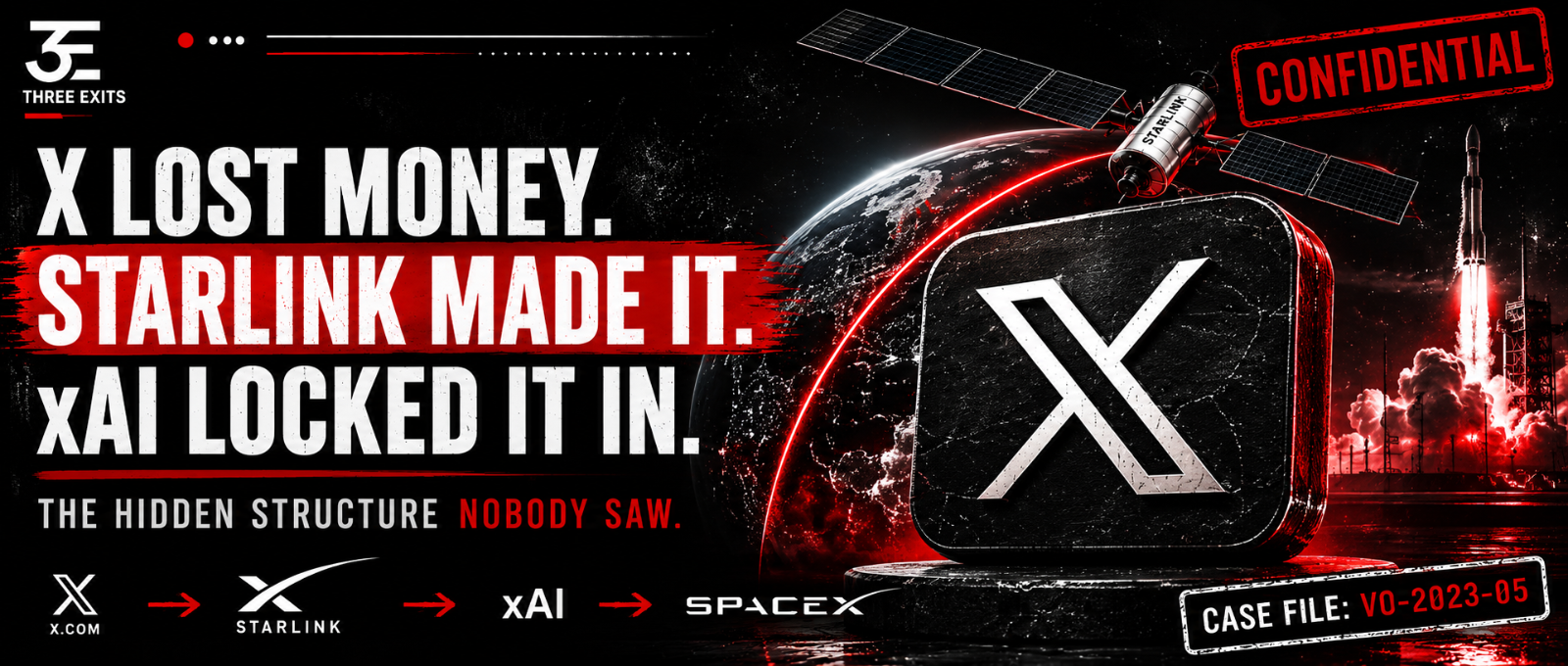
X.com Crashed. Starlink Kept It Alive. xAI Cashed In.
Everyone thinks Musk overpaid for Twitter. The key question is whether Twitter was ever the asset he was buying.
_____________________
THE SETUP
In October 2022, Musk paid $44 billion for Twitter.
The ad business immediately collapsed. By any conventional measure, it was a catastrophic overpayment.
Twitter had been generating 500 million posts a day for over a decade. That is real-time human conversation at a scale no competitor could replicate.
For an AI company training large language models, that data is not a social media byproduct. It is the raw material.
In 2022, AI model training was just beginning to require data at that scale and nobody had yet put a market price on what exclusive access to a corpus like that was worth.
Twitter never had to justify its purchase price. It only had to survive long enough to change what it was worth.
Surviving cost money. A lot of it.
X was carrying $1.2 billion in annual interest from the day the deal closed, on top of running losses as advertisers fled.
The platform could not service its own debt from operations. What kept it alive was the Starlink satellite company, which most coverage of the X story never mentioned.
_____________________
Fast facts:
Twitter acquired for $44 billion in October 2022, financed by $13 billion in bank debt and $7.1 billion from equity co-investors.
X ad revenue fell by roughly 50% in the year after the acquisition as major advertisers suspended spending following Musk's content moderation changes.
Starlink (SpaceX's satellite division): $11.4 billion in revenue in 2025, 39% operating margin, 10.3 million subscribers.
xAI founded July 2023. Raised $6 billion Series B at a $24 billion valuation in May 2024.
xAI acquired X in March 2025 for $33 billion. SpaceX acquired xAI in February 2026.
Combined SpaceX/xAI/X entity valued at $1.25 trillion.
_____________________
THE PLAYBOOK
1. The valuation gap
Twitter was being sold at an ad business price. Musk valued it as an AI data asset. That gap was a significant opportunity.
Ad businesses are valued on revenue multiples. Twitter's were falling.
Wall Street analysts covering the deal were media and tech analysts. They valued ad inventory, user growth and engagement metrics. None of those are the right metrics for an AI training dataset.
An AI company building a large language model needs real-world human text at massive scale. The more varied the conversations, the more useful the data.
Twitter had 500 million posts a day across every language, topic and political position. There is no equivalent dataset available for purchase because no competitor had been collecting it for as long or at that scale.
The market was not pricing that. It was pricing the ad revenue. The dataset happened to be an upside.
The moment xAI was incorporated in July 2023, the plan became visible in hindsight.
Musk closed Twitter's API to outside developers in February 2023. Scraping was blocked.
Pricing for remaining data access was raised to $42,000 a month at enterprise tier. Every step moved the dataset from a public resource to a proprietary one.
By the time xAI acquired X in March 2025, all external AI training access was shut. The data was exclusively xAI's.
Reddit sells data access to OpenAI for roughly $60 million a year covering around 1.5 billion posts. X produces that volume every ten days.
At equivalent rates, exclusive access to the X dataset would cost between $6 billion and $10 billion a year. xAI pays nothing for it.
That saving compounds every year the exclusivity holds.
Takeaway: When an asset is priced by the wrong metric, the opportunity exists until the market recalculates. The window closes fast once competitors see it.
_____________________
2. Use an existing cash business to fund the wait
The $44 billion acquisition was financed on paper by Morgan Stanley and a group of co-investing banks.
In practice, the company that paid the ongoing cost of keeping X alive while the AI strategy matured was Starlink.
Starlink is SpaceX's satellite broadband service. It sells internet access to homes and businesses in remote areas where cable and fibre do not reach. Farmers. Rural communities. Ships at sea.
By 2025 it had 10.3 million subscribers paying between $120 and $250 a month, generating $11.4 billion in annual revenue at a 39% operating margin.
It is a straightforward, capital-intensive, cash-generative infrastructure business.
That cash is what made the X strategy viable. Without it: X's ad revenue had fallen by roughly half.
The $1.2 billion annual interest bill on the acquisition debt had no source of payment from within X itself.
Without external capital, the banks holding the debt would have forced a restructuring.
A restructured X would have needed to license its data to every AI company willing to pay, killing the exclusivity that made xAI's data position valuable.
The whole strategy depends on X surviving intact. Starlink paid for that survival.
The key detail is: Starlink's revenue comes predominantly from individuals and small businesses paying for broadband in places with no other option.
That cash funded the acquisition of a dataset that is now exclusive to one AI company. Rural broadband subscribers financed a move most AI investors never saw coming.
Takeaway: If your strategy requires years before it pays off, you need a cash engine that can fund the wait. Building that engine before you need it turns speculative bets into calculated ones.
_____________________
3. Convert access into ownership
Closing an API is a product decision. Any regulator, court or advertiser pressure could reverse it.
The goal was to move the data advantage from a policy that could be undone to an ownership structure that could not.
Here is the sequence of events:
February 2023: Twitter API closed to outside developers. Free data access ends.
July 2023: xAI incorporated.
October 2024: Twitter privacy policy updated to permit AI training on public posts.
March 2025: xAI acquires X for $33 billion. Third-party AI training access closes permanently.
February 2026: SpaceX acquires xAI in an all-stock merger. Combined valuation: $1.25 trillion.
_____________________
Each step moved the data advantage one layer deeper into a structure that is harder to challenge.
Once xAI owns X, unwinding the data exclusivity requires unwinding the acquisition.
Once SpaceX owns xAI, challenging it requires a legal theory that treats a satellite company, a social network and an AI company as a single regulated market.
No regulator currently has that theory. The FTC can review X in isolation. The FAA oversees SpaceX launches. The FCC regulates Starlink spectrum. Each authority sees one part. None has jurisdiction over all three simultaneously.
The structure was assembled before anyone in a regulatory body had worked out what question to ask.
Takeaway: Regulatory exposure shrinks when an advantage is embedded across multiple businesses in different categories. Each deal reviewed separately leaves the combined structure intact.
_____________________
WHAT GETS MISSED
Most coverage treats this as a story about whether Musk was reckless or brilliant with Twitter. That angle misses what happened.
What actually happened: a profitable satellite business (Starlink) subsidised the survival of a failing social network (X) long enough for an AI company (xAI) to absorb the social network's data and convert it into a proprietary training asset worth more than the original $44 billion purchase price.
The crash of X's ad revenue is real and was severe.
Musk's public statements on content moderation in the months after the acquisition drove a wave of advertiser suspensions. Apple, Disney, IBM and dozens of others pulled spending. Revenue fell by roughly half in the first year.
Whether that was an acceptable cost of the strategy or a near-fatal problem Starlink happened to cover, is genuinely unclear.
Either way, the ad collapse was the trigger that made the rest of the play possible. A thriving ad business would have had no reason to lock down data access or sell to xAI.
_____________________
The debt resolution is the second underreported part.
The $6.5 billion secured term loan from the original acquisition sat on bank balance sheets for two and a half years.
Banks could not sell it because the underlying X business was deteriorating and nobody would buy the debt at face value.
It cleared in April 2025, within months of Trump's inauguration and Musk's appointment to lead DOGE.
The X business had not materially improved. The political environment had.
Credit markets lend against expected future influence as much as current cash flows. Once Musk's proximity to the White House was established, the debt moved.
_____________________
The third thing: nobody has independently verified the largest number attached to this story.
One source cites a National Reconnaissance Office contract worth $19 billion. That figure has not been confirmed and would exceed the combined value of all other cited SpaceX government contracts.
What is confirmed: SpaceX holds approximately $22 billion in US government contracts and a White House review in July 2025 cancelled none of them.
Private companies with undisclosed government revenue are harder to value and harder to challenge than public ones.
_____________________
THE FINAL PICTURE
Musk bought a failing ad business, let it fail further, used a satellite company to keep the debt serviceable, assembled three companies into a structure no single regulator could see whole and ended up with an AI training dataset that may be the most valuable proprietary AI dataset in the world.
Whether xAI delivers on that asset is still to be determined.
The combined entity is valued at $1.25 trillion.
The X ad business is still not recovered. The Grok model, trained on X data, has ground to make up against OpenAI and Anthropic.
The strategy was executed. The outcome is open.
The lesson for founders is not about scale. It is about sequence.
A cash business bought Musk time. Time bought the data. The data bought the AI company.
Most people only looked at the first move and called it a mistake.
_____________________
THE PAPER TRAIL
Bloomberg: Morgan Stanley-led group frees itself from X buyout debt
Read: 5 minutes
The contemporaneous account of the final debt sale. Read via yahoo finance, as Bloomberg is behind a paywall.
_____________________
SpaceX Starlink operating data, 2025
Read: 15 minutes
SpaceX is private and does not publish audited accounts. Revenue estimates come from investor briefings, the Dutch Starlink subsidiary filing and analyst reports. The Dutch subsidiary alone showed $2.7 billion for 2024. The gap between subsidiary filings and total revenue estimates is significant. Understand it before citing either number.
https://tmfassociates.com/blog/wp-content/uploads/2025/07/SSSC-accounts-2024.pdf
_____________________
Senate Democrats' DOGE report, April 2025
Read: 45 minutes
Available via Senate.gov
Estimated Musk's total potential government contract exposure at $2.37 billion against a confirmed SpaceX portfolio of $22 billion. Read alongside the July 2025 White House review that cancelled nothing. The gap between those two documents explains why the debt moved when it did.
_____________________
xAI-X merger terms and data access, March 2025
Read: 5 minutes
The data exclusivity arrangement is what makes the $33 billion X valuation legible. Read the summary via reuters.com.
https://www.reuters.com/markets/deals/musks-xai-buys-social-media-platform-x-45-billion-2025-03-28/
_____________________